
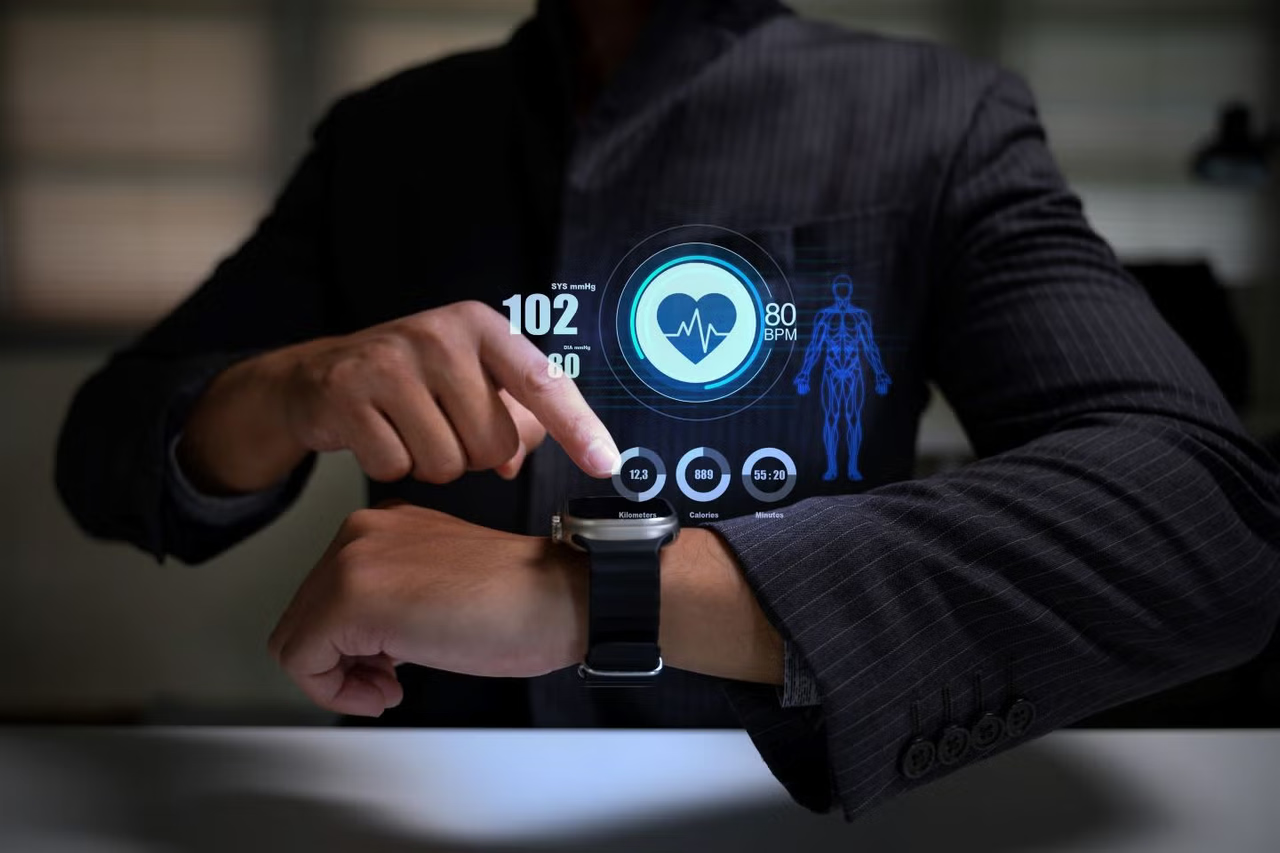

Wearable technology has moved far beyond simple step counters and notification screens. In 2026, smartwatches, smart rings, intelligent earbuds, health trackers, and AI-powered glasses are becoming increasingly connected to the way people communicate, exercise, work, and manage everyday information. The biggest change is not simply the number of sensors inside these devices, but the growing role of artificial intelligence in interpreting the information those sensors collect.
Current market data illustrates how quickly the category is developing. IDC reported 145.7 million wearable devices shipped globally during the first quarter of 2026, with hearables representing the largest category while smart glasses and smart rings emerged as particularly fast-growing areas. IDC also forecasts 13.6 million smart-glasses shipments for the full year, representing 41.4% year-over-year growth.
For readers exploring www silicon-insider .com wearable tech, these developments demonstrate why wearables have become one of the most closely watched areas of consumer technology. The industry is increasingly focused on devices that understand context, deliver useful information without requiring a phone, and provide more personalized experiences.
The Wearable Technology Landscape in 2026
The modern wearable market includes several distinct categories, each serving different purposes. Smartwatches remain important because they combine communication, fitness, health monitoring, applications, and smartphone connectivity in one wrist-based device. Hearables have expanded beyond audio by incorporating voice assistants, translation features, biometric sensors, and increasingly sophisticated interaction capabilities.
At the same time, smaller devices are gaining attention because they can provide specialized experiences without the size of a traditional smartwatch. Smart rings, for example, emphasize discreet health and wellness tracking. Smart glasses are taking another direction by bringing cameras, microphones, speakers, and AI assistants into familiar eyewear designs.
This diversification means that wearable technology is no longer a single product category. Instead, it is becoming an ecosystem of connected devices designed around different parts of everyday life. Industry research published in 2026 describes this broader transformation across smartwatches, fitness trackers, smart glasses, connected clothing, smart rings, medical wearables, and other sensor-based products.
Artificial Intelligence Is Changing Wearables
Artificial intelligence is becoming one of the most important technologies behind the next generation of wearables. Earlier devices generally collected information and presented statistics to users. Newer systems increasingly attempt to interpret those statistics and turn them into useful recommendations, summaries, or actions.
For example, an AI-enabled wearable can potentially combine sleep information, activity levels, heart-rate patterns, workout history, and other signals to provide a more contextual picture of daily activity. This does not mean every AI-generated recommendation should automatically be treated as medically authoritative. Instead, the major development is the transition from passive data collection toward more personalized digital assistance.
The same trend is particularly visible in smart glasses. IDC reported that display-less smart glasses shipments increased 167% year over year in the first quarter of 2026, reaching approximately 2.25 million units. This growth shows that consumers are increasingly interested in glasses that provide audio, cameras, AI assistance, and connected functionality without necessarily placing a screen directly in front of their eyes.
Smart Glasses Are Becoming a Major Wearable Category
Smart glasses are arguably one of the most interesting developments in wearable technology because they can provide hands-free computing. Instead of reaching for a smartphone, a user can potentially ask a question, capture an image, listen to information, translate content, or interact with an AI assistant through eyewear.
The appeal comes partly from the familiar form factor. A smartwatch requires users to look down at their wrist, while smart glasses can integrate technology into something people already understand as everyday eyewear. IDC’s 2026 data shows the category growing rapidly, with display-less smart glasses accounting for much of the recent momentum.

However, smart glasses also introduce difficult questions. Cameras and microphones placed on a person’s face can create privacy concerns in public environments. Recent reporting has highlighted growing debates around recording, consent, data processing, and the possibility of sensitive information being captured unintentionally.
For www silicon-insider .com wearable tech, smart glasses therefore represent both an innovation opportunity and a reminder that successful wearable products need strong privacy design alongside impressive technical capabilities.
Smart Rings Offer a Different Approach to Health Tracking
Smart rings have attracted significant attention because they offer a more discreet alternative to watches and fitness bands. A ring can continuously remain on the finger without requiring a display, making it particularly suitable for people who want health and wellness information without constantly interacting with a screen.
The category is also becoming commercially significant. Current industry reporting indicates strong interest in smart rings, while major wearable companies continue expanding health-focused ecosystems. Oura, one of the best-known companies in this segment, is also preparing for a major public-market milestone, illustrating the increasing commercial importance of ring-based health technology.
The central advantage of smart rings is not necessarily having more features than a smartwatch. Instead, their value can come from comfort, discreet design, long-term wearability, and continuous data collection. This makes them especially relevant to sleep tracking and wellness applications where users may prefer wearing a lightweight device overnight.
Health and Wellness Remain Central to Wearables
Health monitoring continues to be one of the strongest reasons consumers purchase wearable devices. Modern products can monitor a growing collection of measurements, including heart rate, activity, sleep-related information, exercise performance, and other physiological signals. As sensors become smaller and software becomes more sophisticated, manufacturers are attempting to turn these measurements into increasingly understandable insights.
Academic research published in 2026 describes smart wearables as increasingly important tools for continuous health tracking and personalized healthcare applications. However, consumers still need to distinguish between wellness information and clinically validated medical measurements. A wearable can provide useful trends without necessarily replacing professional medical evaluation.
Apple’s latest wearable developments also demonstrate this shift toward personalized wellness. Its 2026 Apple Watch generation introduced a readiness score based on factors including sleep patterns, heart-rate variability, and workout intensity, showing how manufacturers are attempting to make large amounts of biometric data easier for ordinary users to understand.
Key Wearable Categories in 2026
| Wearable Category | Main Use | Major Development |
|---|---|---|
| Smartwatches | Health, communication, fitness | AI-assisted health insights |
| Smart Rings | Sleep and wellness tracking | Discreet continuous monitoring |
| Smart Glasses | Hands-free computing | AI assistants and cameras |
| Hearables | Audio and communication | AI, translation and health features |
| Fitness Trackers | Activity and wellness | Improved sensors and analytics |
The Role of Connectivity and Personalization
Connectivity is another major factor shaping wearable technology. Wearables increasingly work as part of broader digital ecosystems rather than as isolated products. A watch can communicate with a smartphone, wireless earbuds, health applications, smart-home devices, and cloud-based services.
This connected approach creates opportunities for more personalized experiences. A user’s wearable could understand whether they are exercising, commuting, working, or relaxing and provide different information depending on the situation. AI can potentially make those interactions more natural by allowing people to use conversational commands rather than navigating complicated menus.
For www silicon-insider .com wearable tech, this development is particularly important because the future of wearable computing may depend less on adding another isolated feature and more on how effectively different devices work together.
Privacy Could Shape the Next Stage of Wearable Growth
The more information wearable devices collect, the more important privacy becomes. Health information, location data, voice recordings, images, movement patterns, and daily routines can all reveal highly personal details. This makes data protection an essential part of wearable product development rather than an optional feature.
Smart glasses make the issue particularly visible because cameras can capture people who are not wearing the device and may not realize they are being recorded. Recent reporting has highlighted public concerns surrounding AI glasses, including questions about consent, data handling, and transparency. Some companies are exploring approaches such as camera-free designs, user-activated recording, and greater local processing to address these concerns.
Consumers can therefore expect privacy controls to become an increasingly important selling point. Clear recording indicators, understandable permissions, local processing, encryption, and transparent data policies could influence how comfortable people feel using wearable devices in public and private environments.
Wearable Technology Is Also Changing in India
The wearable market is evolving in India as consumers become more selective about the devices they purchase. Recent IDC data reported by Moneycontrol showed Indian wearable shipments falling 7.4% year over year to 24.7 million units in the second quarter of 2026, while average selling prices increased 8.8%. This indicates a market shifting from pure volume growth toward products with greater perceived value.
This change could encourage manufacturers to concentrate on better health features, improved build quality, stronger software, and differentiated experiences rather than competing primarily through low prices. Smart glasses and health-oriented devices may consequently gain greater attention as consumers look for technology that provides practical benefits.
For someone researching www silicon-insider .com wearable tech, India’s changing market is an important example of how wearable adoption can develop differently across regions. Price remains important, but consumers are increasingly evaluating what a device can actually do over its useful lifetime.
What the Next Generation of Wearables Could Look Like
The next generation of wearable technology is likely to focus on reducing friction. Instead of requiring users to constantly open applications, interact with screens, or manually interpret data, future products may increasingly anticipate what information is relevant at a particular moment.
Several developments are likely to remain important:
- More capable AI assistants integrated directly into wearable hardware.
- Smaller and more energy-efficient sensors for continuous monitoring.
- Greater integration between watches, rings, glasses, earbuds, and smartphones.
- Stronger privacy controls and more local processing of sensitive information.
- Increasing personalization based on long-term user data.
Battery life will remain another important challenge. More powerful AI processing, continuous sensors, cameras, and connectivity can increase energy consumption. Manufacturers therefore need to balance functionality with comfort, weight, battery capacity, charging requirements, and reliability.
Why Wearables Are Moving Beyond the Smartphone
The smartphone remains central to digital life, but wearable technology is beginning to move some interactions away from the traditional screen. Earbuds can provide information through audio, watches can display short notifications, rings can quietly track health information, and smart glasses can potentially provide hands-free assistance.
This does not necessarily mean wearable devices will replace smartphones in the immediate future. Instead, the more realistic development is a division of responsibilities. The smartphone can remain the primary computing and display device while wearables handle quick interactions, continuous sensing, health monitoring, communication, and context-aware assistance.
That transition helps explain why www silicon-insider .com wearable tech is a relevant topic for understanding today’s broader technology landscape. Wearables are increasingly becoming interfaces between people and digital services rather than simply accessories connected to phones.
Conclusion
Wearable technology in 2026 is entering a more sophisticated phase. Smartwatches continue to evolve, smart rings are strengthening their position in health and wellness, hearables are gaining AI capabilities, and smart glasses are emerging as one of the industry’s fastest-growing form factors. Global shipment data confirms that the market is expanding across multiple device categories rather than relying on a single product type. The most important transformation is the combination of sensors, connectivity, artificial intelligence, and personalization. Future wearables are likely to focus less on simply displaying information and more on understanding context and delivering useful assistance. At the same time, privacy, accuracy, battery life, affordability, and transparent data practices will remain essential challenges.